
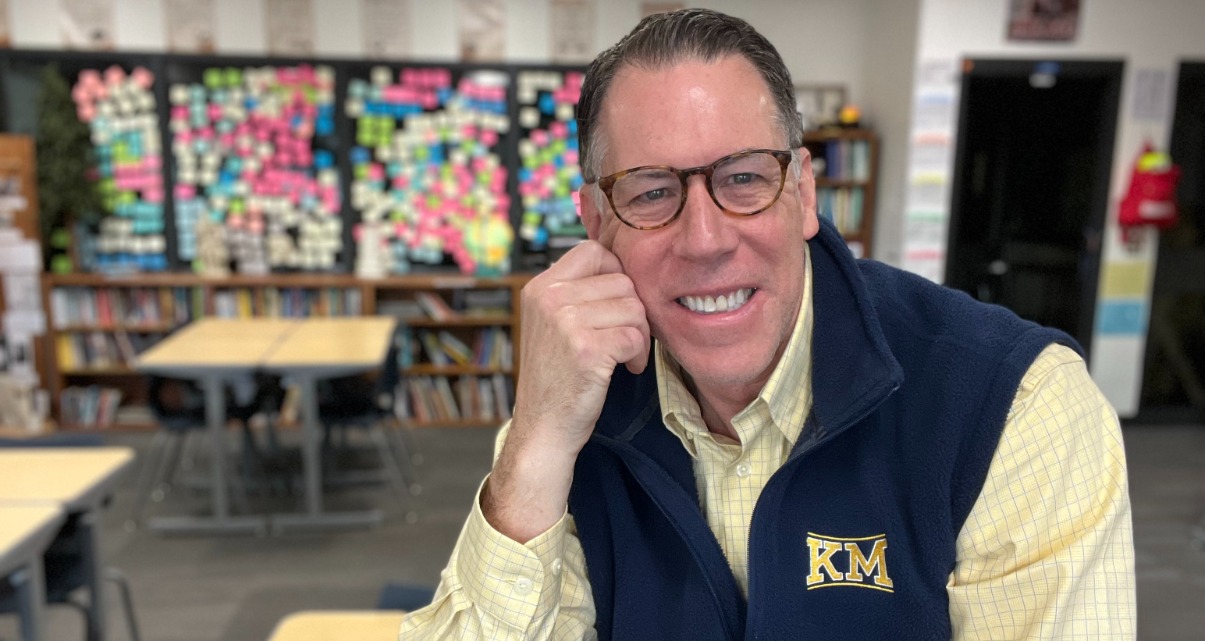

Terry Kaldhusdal met his wife, Janet, while traveling in New Zealand. She was born and raised in Oconomowoc. More than a year later, they reunited in Los Angeles, his hometown, where he worked as a newspaper reporter. They lived there for six years, but one Saturday morning, Janet woke up and said, “Do you want to have kids?” He replied, “Of course.” “Well,” she said, “it’s not going to be here.” Terry knew what that meant. He has now lived in Oconomowoc for 30 years, and they have three grown children who are currently traveling the world themselves. Not only did he follow her to Oconomowoc, but he also followed her into education. Terry loves this small town and everything it has to offer.
About Terry Kaldhusdal
Q: Please tell us a little bit about your family.
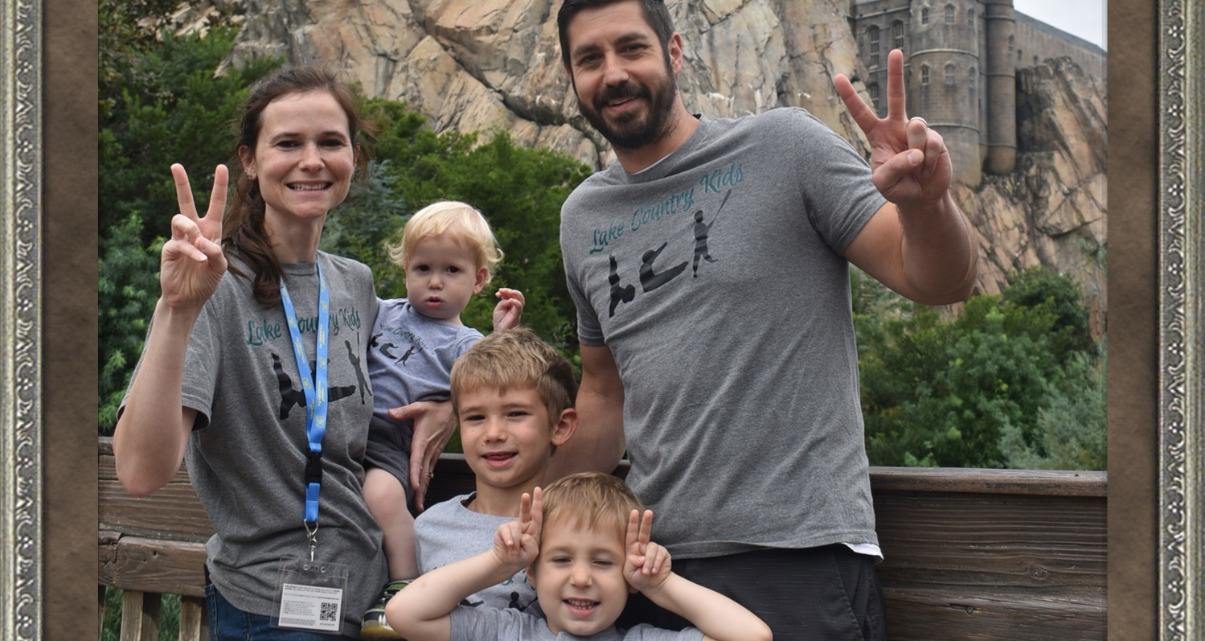
Janet and I have three grown children. They are all taking very different paths as adults. My oldest, Tazmin, married a German who we adore. She and Moritz live in Germany and we visited there this last summer and can’t wait to return. Tazmin is a great barometer on how the world has changed. She works for multiple American groups and companies from her home in Germany. She’s very busy trying to make this world a better place for all of us. My son, Hal, works as a physical therapist in the Twin Cities and takes comfort in relieving people of their pain. Kahlil is my youngest and graduated from UW last year and has since joined the Peace Corps. He is scheduled to travel to Gautamala in March. I’m incredible proud of all of them.
Q: Please tell us about your life and what you do (whether working in our community, a business owner, volunteer, etc.). How did you choose that path?
I’ve taught in the Kettle Moraine School District for 30 years. The support for public education in KM continues to inspire and fuel me and my students. I currently teach 6th grade. My wife and I coach our middle school speech team, where our students learn to speak with conviction. We also coach our National History Day team, where our students learn that evidence matters.
The two of us also coordinate the Art of Writing, Young Authors and Artists Conference at the Milwaukee Art Museum. The conference was founded by John and Pat Hallagan more than 30 years ago. It’s a day in December when the museum is closed to the public allowing students to roam the museum in search of inspiration. They spend the day surrounded by world-class art. Every year a student will write in their evaluation “This was the best day of my life.” There’s nothing like it.
I am also on the board of the Friends of Oconomowoc Parks and Trails, which is an incredibly selfless group that works tirelessly to improve the open spaces in town. Over the last 13 years, I’ve produced numerous documentaries. Two for the Oconomowoc Historical Society, one for the 100th anniversary of the Milwaukee Auto Show, and one celebrating KM’s 50th anniversary. I produced two films with my good friend Mike Bernhagen on end-of-life care, which played more than 2,000 times on PBS stations around the country.
Q: What do you love most about what you do?
All of these experiences and the people I get to work with, including my students, give me great hope for the future. A local politician and I were talking recently and he was worried about the future. I explained to him that my students are more empathetic, tolerant, and curious than my generation ever was. It’s not hyperbole to say that I learn more from my students than they’ll ever learn from me.
My National History Day kids have taught me about the 200-day marches in Milwaukee. Also about Lutie Stearns, who brought public libraries across the state, and why the Milwaukee Airport is named after Billy Mitchell, which is a crazy story.
I had two students who fought hard to get an interview with Dr. Donald A. Henderson. He was the doctor who diplomatically had the U.S. and Russia work together to rid the planet of smallpox during the Cold War. They wanted the truth from a primary source and Dr. Henderson finally relented and spoke with them. They produced a beautiful documentary, and soon after Dr. Henderson died. I knew nothing of that story. The bottom line is I love what my students and my community teach me.
Q: What was the most difficult challenge in getting to where you are now or in your life?
I have been very blessed over the years. So many doors of opportunity have come my way. Every teacher should be so lucky. The most difficult but most important moment was giving up control. My work outside of the classroom taught me that history is not a simple timeline of this happened, then this happened, and then this happened. It’s much more nuanced than that. It’s really about my students telling me, here’s what I know, how I know it, and why it matters. I became a much better teacher when I began to value their views of the world. Sometimes my students have an “aha” moment but many times I’m the one with an aha moment. Those moments were few and far between when I was the “sage on the stage”.
Q: What is the most rewarding part?
The most rewarding part of teaching is having a window to the future. I get a front-row seat to the shape the world is taking and from my perspective, despite the news of the day, a bright future lies ahead. Everyone should be so lucky as I am to work with kids who are hungry to learn.
Q: What are some of your future goals? Do you have anything exciting coming up that you would like to share?
A small group of teachers from across the country each wrote a chapter for a book titled, 6th Grade Ready: Expert Advice for Parents to Navigate the Year Ahead. That process ignited an idea to write a book on Increase Lapham, my favorite Wisconsin historical figure. I have 10 chapters completed and its working title is How Lapham Learned. He was a self-taught archeologist, biologist, meteorologist, environmentalist, and geologist, to name a few. Through paper and pencil, he connected with experts from around the world and that’s how he gained their respect and became an expert to help Wisconsin move “forward”. We could all learn from his grit, kindness, and curiosity.
Q: What advice would you give to someone interested in doing something similar to what you have done/are doing?
The first lesson on the first day in my classroom begins with this question: What is the most important thing you need to learn? My 6th graders often say, “Raise your hand”, “History”, “Mathematics”, and even “Don’t chew gum in the classroom”. I then explain that in my opinion, the most important thing we all need to learn is how to learn. That’s true for my students and it’s true for me. The day I stop learning is the day I should stop teaching.
Terry Kaldhusdal & Our Community
Q: What is your favorite thing about our community, favorite thing to do, or something unique about our community that you love? (Feel free to share as much as you’d like!)
Oconomowoc was at its best recently when much of the world had turned inward. The community came together and raised nearly $2 million in a short amount of time to purchase the land which is now Rockwell Park. My in-laws like to tell the story of their grandfather, who immigrated from Lebanon. They quote their Gido who said, “This is heaven on Earth.” Walking around Fowler Lake, and watching the sunrise or the sunset at the newly created Rockwell Park is “heaven on Earth”. Historically, Rockwell is one of many parks that the community rallied to create, including Fowler Park and Bender Beach. All three of these parks were created by the community for the community.
Q: Who is an interesting person you’ve met here in our community, and how have they inspired you?
There are far too many people to name, but some of them include Krin Blegen and Emma Manion, two of my students who inspired me with their work ethic and creativity with the national award-winning history projects. Mike Herro, who I consider the hardest-working man in Oconomowoc. He gives, gives, gives, and asks for nothing in return. Katie Miller works tirelessly in the shadows of this community but deserves our thanks every day. Sue Herro, who is the most giving and selfless person I’ve ever met. And Lisa Baudoin, of Books & Company, who works around the clock for all of us and finds the right books in my hands and my students’ hands.
Q: Do you have a favorite coffee shop, cocktail shop, or restaurant?
Friends from Florida recently visited here for the first time and I took them to Sobie’s Restaurant on Wisconsin Ave. They had never experienced a Wisconsin Old Fashioned. They now have a new favorite drink. And, they said, “The walleye is so good it can’t be legal.” Mike and Lydia Sobal, who own and operate the restaurant, have built a beautiful place with an amazing vibe. I love it for brunch, lunch, and dinner. The reality is there are so many great establishments in town, that you can’t go wrong.
Q: What 3 words would you use to describe our community?
Scenic, giving, and historic.
For Fun
Q: What is something interesting that most people don’t know about you?
Sixth man became the 44th President of the United States.
Q: What is your favorite book, TV show, movie, poem, or song? Why?
My favorite adult book is The World According to Garp, which inspired me to write and strangely to teach. My Thursday nights in college evolved around the show Cheers. My friends and I loved the idea of having a bar “where everyone knew our name” and tolerated our differences. Years later, that bar became The Pub in Oconomowoc, which sadly Aelred and Bernadette Gannon closed when they retired.
Very few know of my favorite movie. Avalon was directed by Barry Levinson and reminds me of my grandfather, who immigrated here in 1924 from Kaldhusdal, Norway, and my father-in-law, Chuck Herro, who was a cornerstone of Oconomowoc.
My favorite poem is “What Teachers Make” by Taylor Mali, which delves into personal experiences to examine the themes of education, values, and integrity. Many have heard it, but few give Mali credit. It’s one of many poems he has written that I frequently revisit.
One song holds “the key to the universe” — which is actually a line from another Bruce Springsteen song — and that is “Born to Run”. Bruce somehow built an entire world of angry parents, teen angst, love, cars, and hope in 4 minutes and 30 seconds. It’s all there. I’ve seen Springsteen 40 times in concert and I hope I have the opportunity to see him 40 more times.
Q: Who inspires you to be better?
My wife continues to be my ballast and helping me focus on our shared priorities.
Q: If you were a drink (can be a coffee drink, alcoholic, non-alcoholic, etc.), what would you be?
That’s easy. A Wisconsin Old Fashioned because the preparation to make one is unique. It features brandy instead of whiskey, muddled fruit, and has a distinctive Badger state style. A Wisconsin Old Fashioned suggests a distinctive and unique personality, perhaps with a blend of traditional and unconventional elements. It’s a classic and timeless cocktail, so the comparison might imply that I have a timeless or enduring quality. Best of all, it’s an incredibly humble drink. This is all in fun, right?
Q: If you could have lunch with anyone, who would it be with? Why?
Bruce Springsteen because his concerts are part circus, part dance party, part political rally, and an old style tent revival. It’s been said that if Elvis Presley and Bob Dylan had a baby its name would be Bruce Springsteen. His songs about his father, mother, and parenthood have especially moved me. I love how he doesn’t blame his father for his shortcomings, but instead tries to find the context and understand his father. We could all learn from that mindset.
Q: What is something on your bucket list?
Return to the Abel Tasman National Park in New Zealand, which is where I met my wife. It has no roads, sits along the Pacific Ocean, and is one of the two most beautiful places in the world, the other being Kaldhusdal, Norway, which took me 10 hours to hike to this past summer with my wife, two of my children, and two Norwegian cousins. It was amazing.
Q: What makes you the happiest?
When one of my students has an ‘aha’ moment, their face lights up. At that moment, all is good in the world—or giving my wife a kiss.
Q: Any general life advice you would like to share?
While speaking with conviction is important, it’s more important to remember that evidence matters.
Where to Find Terry Kaldhusdal
Email: kaldhust@kmsd.edu